English
Intent: Reading, Writing, and Oracy
At Rockland and Surlingham Primary Schools, we believe that all children can become confident, articulate readers, writers, and speakers. Guided by our values of Believe, Explore, and Achieve, we aim to inspire a lifelong love of language, curiosity, and self-expression. Every element of our teaching is carefully planned to ensure children develop the skills, confidence, and independence to communicate effectively across all subjects and contexts.
Reading
We know that reading is the foundation of learning and a vital life skill, which is why we use a structured approach to phonics and reading. Every child is supported to become a fluent reader through Little Wandle Letters and Sounds Revised, high-quality texts, and daily opportunities to read both for meaning and for pleasure.
Children are encouraged to explore diverse books that reflect our community and the wider world, fostering empathy, imagination, and enjoyment. Because we believe in the power of reading, we provide library visits, Reading Cafés, author events, and curated classroom collections to nurture a culture where reading is celebrated and shared.
Early Years Foundation Stage:
• Nursery children explore phonics through short, playful sessions that develop listening, sound awareness, and letter recognition.
• In Reception, children begin decoding and spelling Phase 2–4 GPCs, building fluency and accuracy.
• Daily oral blending games and storytelling are provided to encourage children to explore language, build vocabulary, and develop early confidence.
Home Reading:
• Decodable books and reading for pleasure texts go home to ensure learning is shared with families.
• We use the Little Wandle Letters and Sounds Revised parents’ resources to engage our families and share information about phonics, the benefits of sharing books, how children learn to blend and other aspects of our provision, both online and through workshops. https://www.littlewandle.org.uk/resources/for-parents/
• Reading logs enable pupils to reflect on texts, record favourites, and communicate progress, helping them believe in their growing abilities.
Reading Fluency & Comprehension:
• The Little Wandle Fluency scheme helps children move from accurate decoding to fluent, expressive reading.
• Small groups matched to children’s fluency stage ensure targeted support, and termly assessments ensure children are challenged appropriately.
• VIPERS (Vocabulary, Inference, Prediction, Explanation, Retrieval, Sequencing/Summarising) supports comprehension, giving pupils strategies to explore texts deeply and confidently.
Reading for Pleasure:
• Daily read-alouds, classroom book corners, library visits, and library van sessions create a rich reading environment.
• PTA book gifts, Reading Cafés, author visits, workshops, and national events foster enthusiasm and independence in reading.
• These opportunities ensure children believe in their reading, explore diverse ideas, and achieve confidence and enjoyment in books.
Writing
We aim to develop confident, creative writers. Because we believe that purposeful writing enhances learning across all subjects, we ensure work has a clear audience, often linking to curriculum themes, while also fostering a love of writing for its own sake.
Children are inspired through:
• First-hand experiences, excursions, and real-life stimuli to spark imagination
• A vocabulary-rich environment that encourages experimenting with new language and structures
• Clear guidance, modelling, and feedback so pupils understand their current level, set realistic targets, and develop independence
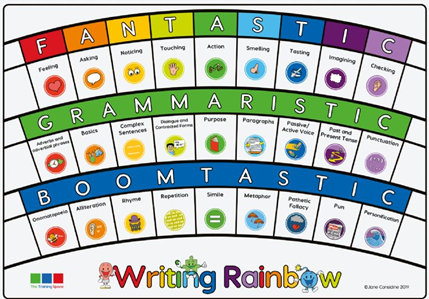
We use The Write Stuff scheme as a framework to support planning, while enriching it with additional grammar and creative writing lessons. Children are taught to:
• Structure and refine their ideas (FANTASTICS)
• Apply grammar accurately (GRAMMARISTICS)
• Use literary techniques to add impact (BOOMTASTICS)
This structured approach ensures pupils believe in their writing, explore their ideas creatively, and achieve technical accuracy and expressive flair.
Oracy – Speaking, Listening, and Drama
Our curriculum ensures that speaking and listening are integral to learning across all subjects, giving children frequent opportunities to:
• Participate in purposeful discussions, debates, and cross-curricular dialogue
• Learn, rehearse, and perform age-appropriate poetry
• Develop public speaking skills
• Rehearse, perform, and critically respond to drama
Through these opportunities, pupils believe in their ideas, explore effective communication strategies, and achieve confidence in oral expression.
Implementation
Phonics & Reading Comprehension
• Daily phonics lessons (Reception/Year 1, 30 minutes) progress from short oral blending sessions in Nursery and Reception.
• Little Wandle Letters and Sounds Revised ensures systematic teaching of GPCs from Phase 2–5.
• Keep-up lessons provide additional support for children with gaps, while Years 3–6 receive catch-up sessions as needed.
Reading Fluency & Guided Reading
• Small fluency-based groups allow targeted, consistent support.
• Whole-school reading together promotes a shared culture of reading.
• VIPERS guided reading explicitly teaches comprehension skills, helping pupils approach texts strategically and confidently.
Reading for Pleasure
• Daily read-alouds, classroom book corners, library access, Reading Cafés, PTA book gifts, author events, workshops, and national events.
• Pupils develop a lifelong love of reading, where they believe in their abilities, explore new worlds, and achieve independence in reading.
Writing, Spelling, Grammar, and Handwriting
• Regular spelling lessons using No Nonsense Spelling with weekly homework
• Language-rich environment promotes vocabulary growth
• Formative and summative assessment in Years 1–6 guides interventions
Assessment & Impact
• Phonics: daily formative, weekly review, half-termly summative, Year 1 Phonics Screening Check, Year 2 re-sits
• Reading & Writing: ongoing formative assessment, structured personal targets, moderated externally
• Reading Fluency – assessed Termly
• Pupils’ progress is monitored to ensure every child achieves their potential